As the Product Design Lead, I am a strategic partner in the end-to-end conception to development of our product. I play an active role in defining the strategy of our product, using design to drive key business metrics of early adoption and user retention. My role consolidates product strategy, user experience and innovation - I can do this because involving AI in my process frees up a lot of time otherwise spent pushing pixels.


There is a struggle to balance calendar constraints while maintaining focus on high-impact tasks. Traditional scheduling tools only provide basic automation, leaving the cognitive burden of prioritization, context-aware rescheduling, and collaboration management on the user.
😰
Too many disconnected workflows – calendars, emails, and messengers don’t talk to each other.
🎨
No personalization – AI tools and agents don’t learn from your past actions and preferences.
🗓️
No real innovation – schedule management hasn’t evolved since GCal (2006) and Calendly (2013).
We realised that solving the productivity problem is complex and instead of beginning a life long quest to find the perfect solution, we started with a small part of the problem space that has been a pain point for everyone in the professional world - scheduling meetings.
The business goal was to create a human-in-the-loop scheduling system that intelligently optimizes calendars based on individual preferences, team dynamics, and organizational priorities. The AI was designed to:
I believe that a design process should be platform agnostic. The recent AI tool innovation has helped me design 10x faster, increasing the time I spend on over all flows as opposed to individual screens.
Scoping Features
In collaboration with PM, and early conversations with CEO to understand business goals
Ideation
Using Vercel v0 to see feasibility within our tech stack. Iterate, iterate, iterate…
Prototype
Design System
Stitch together our early prototype to the final design system (custom on top of shacn)
I usually employ Vercel's v0 for iteration purposes and sometimes use Cursor for executing tasks. v0 is superb for standard UX procedures and strategies, achieving top-notch refinement given the correct prompts. Here's a handful of examples demonstrating how I leveraged v0 in this project.
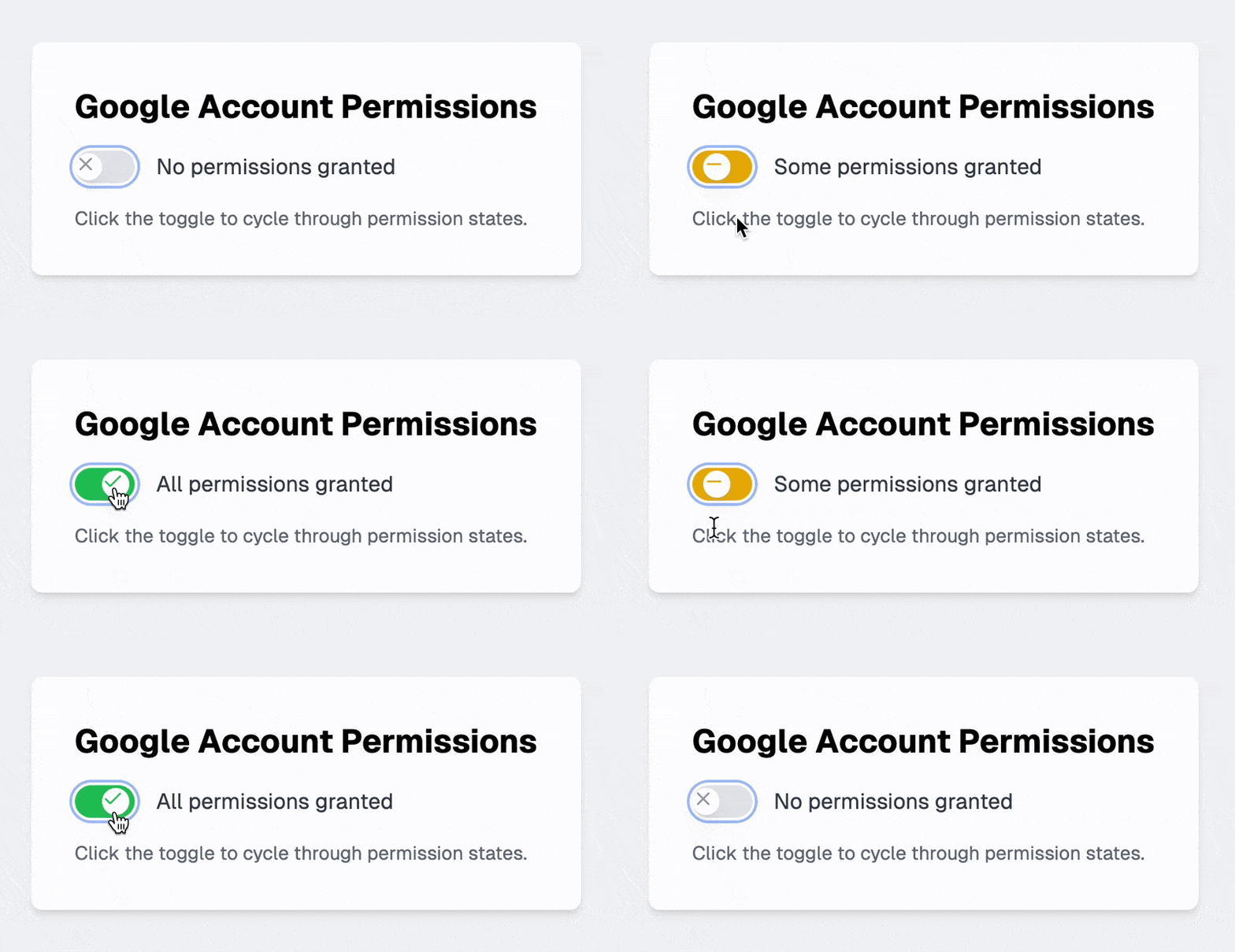
Conventionally, toggle switches only maintain two states - active and inactive. However, for this special situation, we had to engineer a toggle switch exhibiting three states - total, partial and nil. I investigated optimum solutions with v0 and ended up developing a tri-state toggle. This is also a reflection of the nature of designing in startup environments. I suggested a complete revamp of the component rather than devising a non-standard UI element, but due to technical, schedule and manpower limitations, we were forced to adhere to this approach.


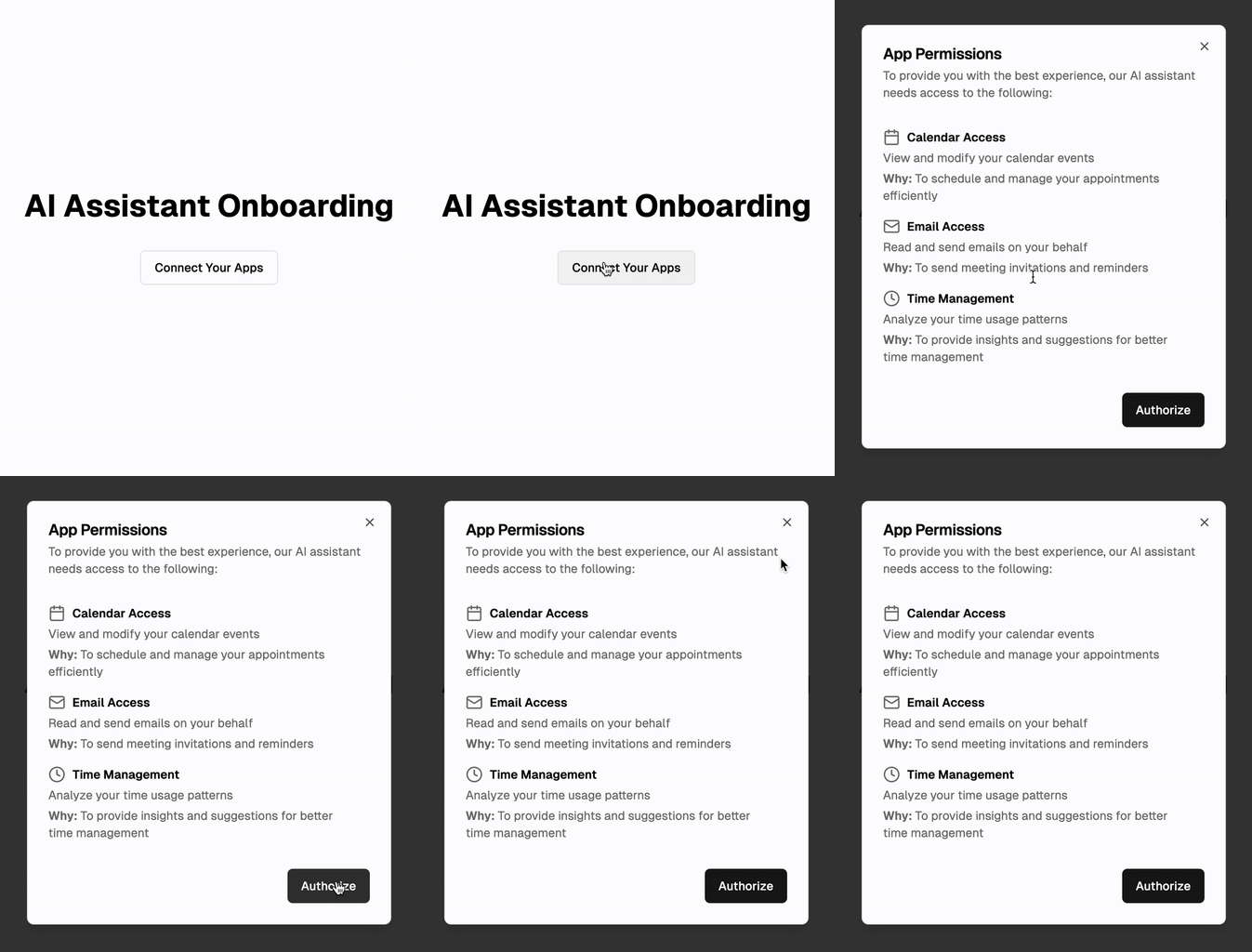
As another instance, I was looking for inspiration to develop an intermediary phase for granting permissions during software integration. Collaborating with v0, I devised two instances. Technically speaking, these were excellent as they're constructed on the identical stack that our production uses. They demand refinements in UI and style, which I plan to execute in Figma.
We loved the second example because it shows a screenshot of which checkboxes to select, and went ahead with that. But as you can see, v0 breaks a lot and needs to designed to fit our brand and to maintain design consistency.

With the actual chat layout, we tried to question the convention and build a semi-chat experience. Our initial hypothesis was the primary goal of users on this platform will be to see their schedule, and that chat will be a small way to modify their schedule.
But, with initial user testing results, it was clear that our target user group wanted to use a chat first experience, akin to how traditional AI tools work. I committed and designed an entire end to end experience of using the Eve chat.
Human-in-the-loop (HITL) in designing AI products is an approach that integrates human involvement and oversight throughout the development and operation of AI systems. This method reframes automation as a collaborative process between humans and machines, rather than a complete replacement of human involvement. Source
I designed Eve with these HITL principles in mind. Here are the ways in which I have intentionally designed our AI system to support the humans using it.
📚 HITL Principle 1
Continuous Human Interaction
HITL involves human experts at various stages, including data annotation, quality assurance, model refinement, and decision-making
✅ What I did
Chat UI
Eve's conversational interface engages users in context-aware dialogues, asking for clarification or approval when ambiguous scenarios arise.

📚 HITL Principle 2
Transparency
By incorporating human interaction at critical steps, the system becomes more transparent and understandable
✅ What I did
Chain of Reasoning
Eve shows it's entire chain of thought and reasoning in real time, and can also be accessed historically.

📚 HITL Principle 3
Judgment Integration
Human judgment and preferences are incorporated into the AI system, ensuring that the technology aligns with human values and needs
✅ What I did
Preferences
Memory & preferences feature ensure that the system evolves through human interaction, reinforcing learning from real-world corrections and preferences

📚 HITL Principle 4
Iterative Improvement
Humans provide feedback to the AI system, creating a continuous loop of refinement and enhancement
✅ What I did
Feedback flow
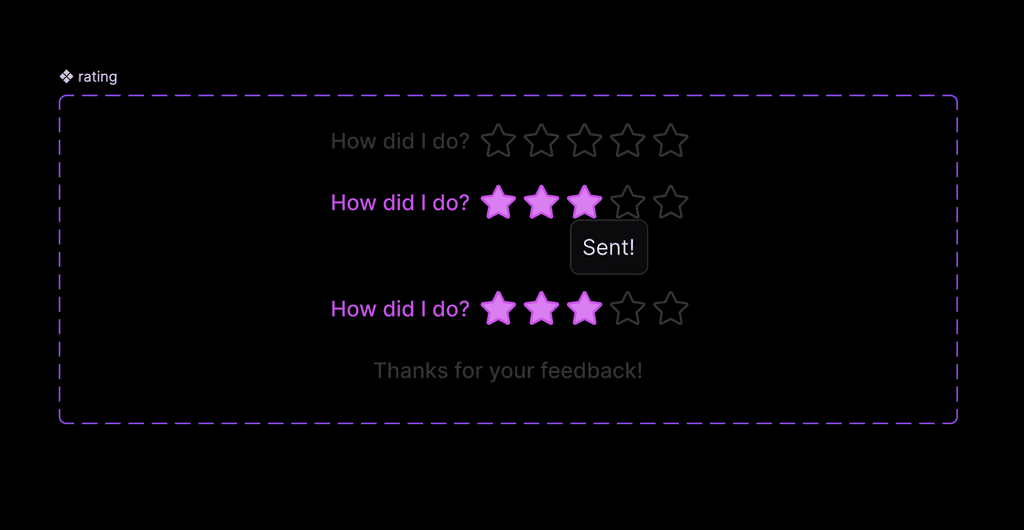
Eve's feedback feature allows users to provide feedback and corrections during scheduling or meeting-related tasks

In a team full of engineers, we can often lose the voice of the user and the direction of the problem we originally sought out to solve. I ensure this never happens, by asking a million questions, during every step of the process to ensure that our team awareness is alive. Every design decision is intentional and made keeping scalability in mind. There is a clear focus on excellence that is comparable to the top of the products in our space.
While I am accepting of negotiations during the discovery phase, I like to be very clear and communicative during the post production phase. Making sure our developed version looks exactly the same as the Figma is an unglamourous but extremely important part of my job's success.
To be honest, it has always been difficult to define impact for me, because I am someone who loves the process more than the outcome. I personally believe that the initial 3 months we invested in building a 'general one size fits all' solution to productivity - although not successful - was highly impactful because it sharpened our focus on what we want to build and provided a spectrum of success for every feature definition conversation we have had. This mindset has so far helped me churn out ideas without judgment or attachment and inspired me to follow with the discipline the path it takes to get to the outcome(s).